
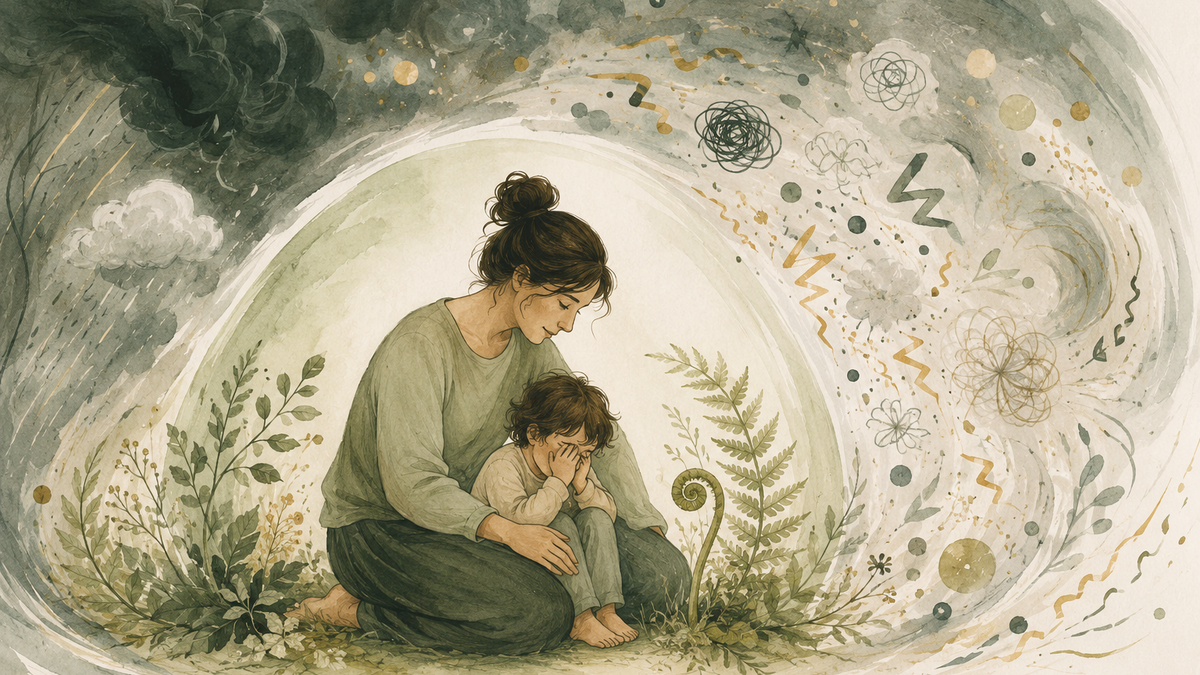
Meltdowns vs Tantrums: Understanding the Difference
A child is crying on the floor because it is time to leave the park.
Is it a tantrum? A meltdown? Does the difference even matter?
The words are often used interchangeably, but they can describe quite different experiences. Understanding what may be happening underneath the behaviour can help us decide what kind of support a child needs in that moment.
A tantrum and a meltdown can look very similar
From the outside, both might involve crying, yelling, dropping to the floor, throwing things, hitting, running away or refusing to move.
The difference is less about what the behaviour looks like and more about what is driving it.
A tantrum is generally a goal-directed expression of frustration. A child wants something, cannot have it, and uses the skills available to them to communicate that frustration. They may still have some capacity to notice what is happening around them, respond to another option, or change course if the situation changes.
A meltdown is better understood as a state of overwhelm. The demands on the child’s system have exceeded their current capacity to manage them. Sensory input, fatigue, hunger, uncertainty, social demands, disappointment, transitions or many small stressors may have accumulated until the child can no longer hold it together.
In real life, the distinction is not always neat. A child can begin with frustration about a limit and become increasingly overwhelmed. We do not need to perfectly categorise every difficult moment before we respond.
What matters most is asking: what capacity does this child have right now, and what support is likely to help?
A meltdown is not the time for teaching
When a child is highly overwhelmed, access to language, flexible thinking, perspective-taking and problem-solving can become much harder.
This is why explanations such as “You knew we had to leave” or “Tell me why you are behaving like this” often do very little in the middle of a meltdown.
The child may hear the words without having the capacity to use them.
At this point, the priority shifts from teaching to safety and regulation.
Use less language, not more
Adults often become more verbal when children become more distressed. We explain, negotiate, remind and repeat.
For an overwhelmed child, this can become more information to process.
Try reducing your language.
“I’m here.”
“You’re safe.”
“I won’t let you hit.”
“We’ll talk when your body is calmer.”
Sometimes, just your presence is enough.
You do not need to find the perfect sentence. Repeating something simple like “I’m here” can provide a predictable anchor without asking the child to process or respond.
Sometimes, just your breath is enough
Co-regulation does not always require a strategy that the child has to copy.
Taking slow, audible breaths – in through the nose and out through the mouth – can support your own regulation and create a steady rhythm around the child.
The aim is not to tell them to “take a deep breath” when they are unable or unwilling to do so. It is to regulate your own pace, voice and body while remaining available.
Some children will naturally begin to match that rhythm. Others will not. Either is okay.
Reduce demands where you can – without abandoning every boundary
During a meltdown, think about what can temporarily become simpler.
Can the lights be dimmed? Can other people move away? Can you stop asking questions? Can the child have more physical space? Can a non-essential task wait?
This does not mean every limit disappears.
Safety boundaries still matter. You can block hitting, move dangerous objects, or help a child leave an unsafe environment while staying as calm and predictable as you can.
“I won’t let you hurt me. I’m moving back, and I’m staying nearby.”
Connection and boundaries can exist together.
What about tantrums?
A child who is frustrated because they cannot have something still needs support, even if they are not overwhelmed in the same way.
You can acknowledge the feeling without changing an appropriate limit.
“You really wanted the blue cup. It’s disappointing that it’s dirty.”
“You wanted to stay at the park. It’s time to go.”
The goal is not to reward distress or talk a child out of the feeling. It is to make the boundary clear while helping them experience disappointment within a safe relationship.
The learning comes later
Once the child is genuinely calm, there may be an opportunity to unpack what happened.
This might be very brief.
“That was a hard transition. You really wanted to stay.”
“Your body got very overwhelmed when the room became noisy.”
“Next time, we can try leaving before it gets that busy.”
Repair can come later too. If someone was hurt, something was broken or words were said in anger, support the child to notice the impact and participate in a meaningful repair once they have access to the skills required.
That might look like checking on someone, helping rebuild something, getting an ice pack, drawing a picture, or talking about what could help next time.
A forced apology in the middle of overwhelm is rarely the most important part.
You do not need to get the label perfect
Sometimes we will know that a child is in a full state of overwhelm. Sometimes we will see frustration, testing, fatigue and dysregulation all mixed together.
The useful question is rarely “Is this a tantrum or a meltdown?” in isolation.
A better question is:
What is this behaviour telling me about what this child can manage right now?
Because whether the child is disappointed, overloaded or somewhere in between, they still benefit from an adult who can hold the boundary, notice the need underneath the behaviour, and stay connected while the hard moment passes.